
What Makes Canada So Unique in 2026?
Canada, the world’s second-largest country by land area, is a land of breathtaking natural beauty, abundant resources, and vibrant cultural diversity. From the rugged mountains of British Columbia to the modern skylines of Toronto and Montreal, Canada represents a balance between wilderness and progress. Let’s dive into what truly defines this incredible country — from its geography and population to its economy, resources, and global influence.
Learn More: 10 Canadian Provinces and 3 Territories: Complete Guide (2026)
Canada’s Geography: What Makes Its Landscape Uniquely Diverse?
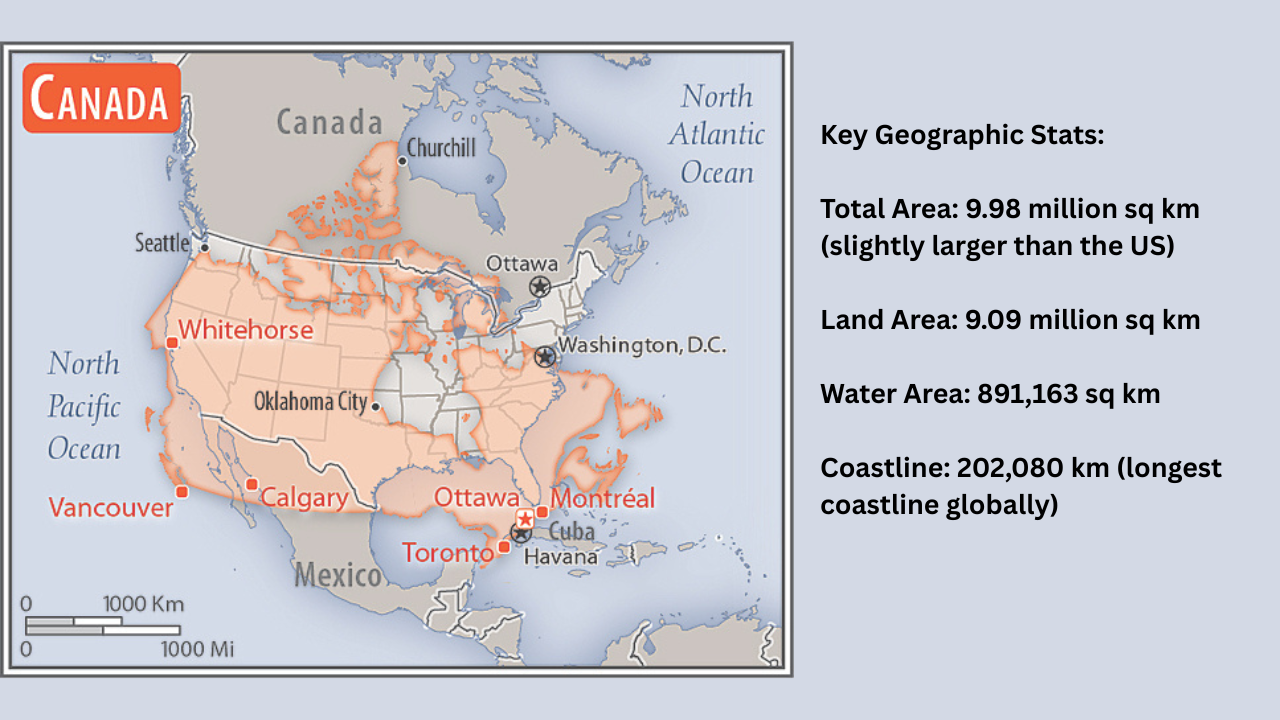
Spanning nearly 10 million square kilometers, Canada’s geography features everything from Arctic tundra to fertile plains. It’s bordered by three oceans — the Atlantic, Pacific, and Arctic — giving it the world’s longest coastline of approximately 202,080 km.
Key Geographic Facts (2026):
-
Total Area: 9.98 million sq km (slightly larger than the U.S.)
-
Land Area: 9.09 million sq km
-
Water Surface: 891,163 sq km
-
Coastline: Longest globally at 202,080 km
-
Highest Peak: Mount Logan, Yukon (5,959 m)
Canada’s geography is defined by its western mountain ranges, central plains, and forested eastern regions. More than 60% of Canada’s landmass remains wilderness, contributing to its reputation as one of the planet’s most nature-rich nations.
Canada’s Population: Who Lives in This Vast Land?
With a 2026 estimated population of 39.4 million, Canada’s population continues to grow steadily, largely due to immigration, one of the highest per capita in the world. Most Canadians live near the U.S. border, taking advantage of warmer climates and major trade routes.
Population Insights (2026):
-
Total Population: 39.4 million
-
Urbanization Rate: 82.3%
-
Major Cities:
-
Toronto: 6.8 million
-
Montreal: 4.5 million
-
Vancouver: 2.8 million
-
Calgary: 1.7 million
-
Ottawa (Capital): 1.5 million
-
Canada celebrates multiculturalism, with over 200 ethnic backgrounds represented. The country’s two official languages — English and French — reflect its colonial past and its ongoing commitment to bilingualism.
Canada’s Natural Resources and Environment: A Wealth of Potential
Canada’s natural resources are among the richest on Earth. Vast forests, freshwater reserves, and mineral wealth drive its economy, but sustainability remains a top concern in 2026 as Canada advances toward net-zero carbon goals by 2050.
Key Resource Statistics (2026):
-
Forest Coverage: 34.1% of total land (3rd-largest in the world by total forest area)
-
Freshwater Supply: Holds nearly 20% of the world’s freshwater
-
Top Natural Resources: Oil, gas, uranium, gold, nickel, potash, and timber
-
Energy Mix: 65% renewable (driven by hydropower and wind energy growth)
Canada plays a leading role in international climate efforts, including commitments under the Paris Agreement and the UN Biodiversity Framework. Provinces such as British Columbia and Quebec are leaders in green energy innovation.
Canada’s Economy: How Strong Is It in 2026?
Canada’s economy ranks among the top 10 globally, built on a mix of natural resources, advanced manufacturing, and service industries. Strong trade ties — especially with the United States, China, and the European Union — continue to fuel growth.
Economic Highlights (2026):
-
Nominal GDP: USD 2.12 trillion (ranked 9th worldwide)
-
GDP per Capita: USD 51,600
-
Top Industries: Energy, automotive, aerospace, technology, forestry, and healthcare services
-
Main Exports: Crude oil, cars, natural gas, gold, and lumber
-
Inflation (2025): 2.3%
-
Unemployment Rate: 5.5%
With a stable banking system and growing innovation hubs in Toronto, Vancouver, and Montreal, Canada remains a magnet for foreign investors and tech startups.
Canada’s Government and Political Structure: A Modern Democracy
Canada is a federal parliamentary democracy under a constitutional monarchy. The British monarch serves as the official head of state, represented domestically by the Governor General, while the Prime Minister heads the government.
Quick Governance Facts:
-
Capital: Ottawa
-
Provinces/Territories: 10 provinces, 3 territories
-
Current Prime Minister (2026): Justin Trudeau (Liberal Party)
-
Government Focus Areas: Climate policy, healthcare funding, Indigenous reconciliation, and housing affordability.
Canada’s Military and Global Role: A Force for Peace
The Canadian Armed Forces (CAF) maintains a respected international reputation for professionalism and peacekeeping. Canada is an active member of NATO, cooperating closely with allies to uphold global stability.
Defense Statistics (2026):
-
Active Personnel: 68,000
-
Reserve Personnel: 26,000
-
Defense Spending: 1.6% of GDP (~USD 33 billion)
-
Global Deployments: Over 1,200 troops in NATO and peacekeeping missions
Canada’s strategic presence in the Arctic also plays a key role in defending the North and contributing to international Arctic research and cooperation.
Canada’s Transportation and Infrastructure: Connecting a Country This Vast
Canada’s transportation network binds together its immense geography. Its efficient road, rail, air, and maritime systems support both domestic connectivity and international trade.
Infrastructure Stats (2026):
-
Airports: 1,467 (4th largest in the world)
-
Railways: 49,000+ km of track
-
Roadways: 1.1 million km
-
Ports: Major hubs include Vancouver, Montreal, and Halifax
Ongoing infrastructure investments — such as the High-Frequency Rail Project (Toronto–Quebec City) — highlight Canada’s commitment to sustainable transport and economic resilience.
Canada and Space Technology: Reaching Beyond the Earth
The Canadian Space Agency (CSA) continues to lead globally in robotics, satellite systems, and space science. Canada’s partnership with NASA and the European Space Agency has strengthened since the Artemis lunar missions.
Space & Tech Facts (2026):
-
Agency: Canadian Space Agency (CSA)
-
Notable Technologies: Canadarm3, RADARSAT-Constellation, AI-driven Earth observation
-
Innovation Focus: Space robotics, satellite data, and planetary science
Canada’s contributions to international space efforts position it as a global leader in aerospace innovation and sustainable technology.
Canada’s Identity in 2026: A Harmony of Progress and Nature
From its multicultural cities to its pristine national parks, Canada in 2026 stands as a beacon of innovation, diversity, and sustainability. Its balanced blend of modern infrastructure, environmental consciousness, and inclusive governance makes it one of the most livable nations on Earth.
As the world faces new economic and environmental challenges, Canada’s ability to combine economic success with social responsibility and green innovation continues to set it apart — making it not just a beautiful country, but a model nation for the future.
Refereneces:
https://www.cia.gov/the-world-factbook/about/archives/2023/countries/canada/#geography
https://srv1.worldometers.info/world-population/canada-population/
https://www.canada.ca/en/canadian-heritage/services/royal-symbols-titles/royal-anthem.html
https://www150.statcan.gc.ca/t1/tbl1/en/tv.action?pid=1710000901