
Germany Move Cost Calculator
Estimate the total cost of moving from the USA to Germany, including flights, visa fees, shipping, housing deposit, and first-month living expenses. Built in a clean light theme for a simple user experience.
Enter Your Move Details
This calculator gives a planning estimate only. Actual relocation costs depend on shipping company, city, season, visa requirements, and housing availability.
Your Estimated Budget
Total estimated move cost
Recommended savings target
Expected monthly living cost
Affordability check
Cost Breakdown
Move Recommendation
- Move with fewer items and buy bulky furniture after arrival.
- Choose shared housing first if your city is expensive.
- Keep extra cash for deposits, registrations, and local transport.
- Compare shipping against replacing items in Germany.
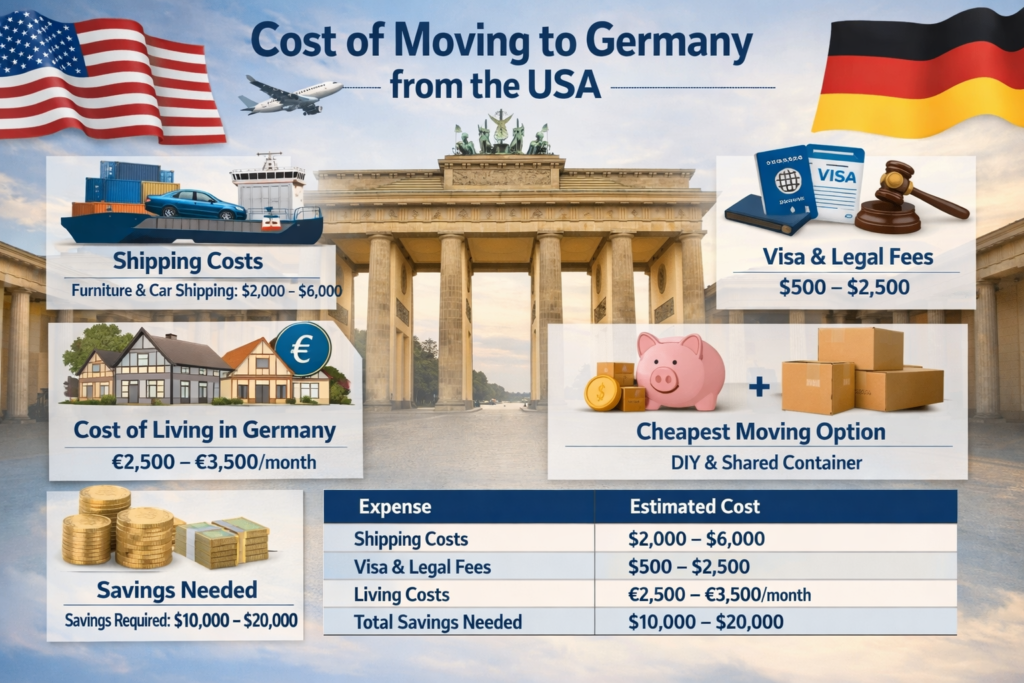
How Much Does It Cost to Move to Germany From the USA?
Moving to Germany from the United States can cost anywhere from a few thousand euros to well over €20,000, depending on how much you ship, whether you move with a car, and how much cash you need for housing and setup.
For a light move with suitcases and no household shipment, many people should expect a much lower entry cost than a full family relocation. But once you add a rental deposit, paperwork, health insurance, and furniture shipping, the budget rises quickly. A one-way flight from the U.S. to Berlin was showing fares starting at about $531 at the time of research, while full container shipping from the USA to Germany was being quoted in the thousands of dollars.
The most important planning rule is simple: your biggest costs are usually housing setup and shipping, not the visa itself. Germany’s official visa fee for a long-stay national visa is normally €75, while housing deposits can reach up to three months’ cold rent, and health insurance is compulsory.
Table of Contents
ToggleWhat does moving to Germany from the USA usually cost in total?
A realistic total depends on the type of move.
- Budget/light move: often about €4,000 to €7,000
- Mid-range move with some shipment: often about €6,000 to €12,000
- Full-household move: often about €12,000 to €22,000+
- Full-household move plus car: often about €13,000 to €25,000+
These are planning ranges, not fixed official tariffs. They are based on current airfare, common visa/residence-permit fees, compulsory insurance, the possibility of paying up to three months’ cold rent as a deposit, route-specific container shipping estimates from the USA to Germany, and current car-shipping estimates.
What is the total cost breakdown for a move to Germany?
The direct answer is that your budget usually splits into five buckets: travel, shipping, legal/admin, housing setup, and first-month living costs.
What does a low-cost move look like?
A low-cost move usually means:
- one-way airfare
- no container
- no car shipping
- temporary accommodation or a room in a shared flat
- basic admin costs only
This is the cheapest realistic path because it avoids the biggest cost driver: international freight. U.S. citizens may in some cases enter Germany without a visa for certain work or study-related long-stay purposes and then apply for the residence permit in Germany, which can reduce upfront embassy costs, though some local authorities may still expect a prior visa because of appointment bottlenecks.
What does a mid-range move look like?
A mid-range move usually includes:
- one-way airfare
- shared container or small shipment
- deposit plus first month’s rent
- legal/admin fees
- health insurance from day one
- enough cash to live before first salary
This is common for solo professionals and couples who do not want to rebuy everything after arrival.
What does a full-household move look like?
A full-household move usually includes:
- one-way airfare
- 20-foot or 40-foot container
- packing, delivery, and customs handling
- housing deposit
- first month’s rent
- legal/admin fees
- insurance
- optional car shipping
This is where costs rise fast. Current route-specific estimates for shipping a container from the USA to Germany put a 20-foot container around $6,400 to $7,500 and a 40-foot container around $11,750 to $13,500, with full door-to-door moves often landing between $7,025 and $21,855 depending on route, volume, and services.
Comparison table: common shipping options
| Shipping option | Typical cost range | Best for | Main trade-off |
|---|---|---|---|
| Shared container / LCL | Around $1,600 average for small loads | Small moves | Slower, shared space |
| 20-foot container | $6,400–$7,500 | Small household | Much higher than luggage-only |
| 40-foot container | $11,750–$13,500 | Large household/family | Highest freight cost |
| Car shipping | $1,200–$2,500 | Bringing your own vehicle | Extra customs/compliance risk |
These figures come from current route and category estimates published by relocation/shipping providers covering USA-to-Germany containers, LCL, and vehicle shipping.
How much does shipping furniture, boxes, and a car to Germany cost?
Shipping is usually the single biggest variable after housing. The more you send, the less “cheap move” this becomes.
How much does container shipping from the USA to Germany cost?
A full container move from the USA to Germany currently sits in the high-thousands to low-five-figures in U.S. dollars. Sirelo’s 2026 USA-to-Germany guide lists a 20-foot container at about $6,400 to $7,500 and a 40-foot container at about $11,750 to $13,500, while total door-to-door moves can run $7,025 to $21,855.
For smaller moves, LCL/shared container shipping is usually the cheapest shipping method because you pay only for the space you use. Sirelo’s LCL guide says typical LCL shipping is 30% to 50% cheaper than FCL for small loads, and its broader shipping guide gives LCL rates averaging around $1,600.
How much does car shipping from the USA to Germany cost?
Current car-shipping estimates usually land around $1,200 to $2,500 for standard vehicles shipped by ocean freight from the U.S. to Germany. Some providers advertise entry-level rates from about $1,000 on baseline routes, but the final number depends on departure port, vehicle size, and whether you use RoRo or container service.
In practice, bringing a car is only worth it if the vehicle has strong personal or financial value. Otherwise, it often turns a moderate-cost move into an expensive one.
When can household goods enter Germany duty-free?
Germany allows duty-free import of personal property when you transfer your normal place of residence from a non-EU country, but there are conditions. Official customs guidance says duty-free clearance is only possible within 12 months after the transfer of residence, and the customs declaration support text says the goods must have been personally used for at least six months at your previous residence. The same customs material also states that the goods may not be lent, pledged, rented, sold, or otherwise transferred, or import duties may become due.
That rule matters because it can save a lot of money on a true relocation move, especially if you are shipping a household or vehicle that clearly qualifies as personal property.
What are the visa, residence permit, and legal costs to move to Germany?
The legal fees themselves are usually not the expensive part. The bigger cost is proving you can support yourself and staying insured while you settle in.
Do U.S. citizens need a visa before moving to Germany?
Sometimes yes, sometimes not upfront. Germany’s official guidance says U.S. citizens can enter Germany without a visa for certain employment or study-related stays and then apply for the residence permit in Germany within 90 days. But official Germany mission guidance also warns that some foreigners authorities may require a prior visa because they are overloaded and appointments are hard to get.
So the safest planning advice is:
- check your exact stay purpose
- check the German mission responsible for your U.S. residence
- do not assume visa-free entry is always the smoothest option
What official fees should you budget for?
The standard official fees are straightforward:
- National visa fee: normally €75 for long stays
- Residence permit fee: local fees vary, but Berlin’s official service portal lists €100 for initial issuance and €93 for renewal for many standard residence permits
- Health insurance: compulsory in Germany, and proof may be required during the visa/residence process
For some move types, proof of funds is also part of the legal reality. Official 2026 guidance for the Opportunity Card says applicants can show sufficient means with a blocked account of €1,091 net per month, and the official studying guidance gives a blocked-account minimum of €11,904 for 2026.
What does it cost to live in Germany after you arrive?
Your moving budget is only half the story. You also need enough money to survive the first months in Germany.
What do official German household spending figures show?
Official federal guidance based on German household data says Germans spent an average of €2,846 per household per month in 2022. Of that, about €1,025 went to accommodation, energy, and housing maintenance, €417 to food, beverages, and tobacco, and €347 to transport. Destatis also reports that main tenant households spent an average of 27.8% of their income on rent in 2022.
That does not mean every newcomer needs €2,846 monthly. It is a household average, not a one-person relocation budget. But it does show the real pattern: housing is the biggest cost center.
What monthly budget should one person expect?
A careful one-person budget depends mainly on:
- city
- room vs private apartment
- health insurance type
- transport choice
- whether you arrive with a job
Two official figures are especially useful as planning anchors:
- Germany requires health insurance, so that cost cannot be ignored.
- The official proof-of-funds benchmark for some 2026 visa categories is €1,091 per month, which is better seen as a minimum floor than a comfortable lifestyle budget in expensive cities.
For transport, the current official Deutschlandticket costs €63 per month and covers local and regional public transport nationwide, though not long-distance ICE/IC/EC trains.
A practical reading of the official data is this:
- shared housing + careful budget: often manageable around the lower end of a starter budget
- private apartment in a major city: noticeably more expensive
- first months are costlier than later months because of deposits, furnishing, and setup
What is the cheapest way to move to Germany from the USA?
The cheapest way to move is usually to move light, use sea freight only if needed, and avoid shipping a full household.
The cost-saving order is usually:
- fly with luggage only
- ship only essentials by shared container/LCL
- use sea freight instead of air freight
- avoid shipping a car unless it is truly worth it
- sell bulky low-value furniture before leaving
Why? Because current relocation sources say:
- LCL/shared container is the cheapest shipping option for small loads
- Sea freight is around five times cheaper than air freight on typical international moving routes
- A full household container is far more expensive than traveling with suitcases only
A second money-saving strategy is legal, not logistical: if your goods qualify as transfer-of-residence personal property, Germany’s customs rules may let you import them duty-free.
How much savings do you need before moving to Germany?
The direct answer is: more than the visa fee, and usually more than one month of living costs.
A useful way to think about savings is by move type:
- Bare-minimum move: about €4,000 to €7,000
- best for: solo mover, no container, no car
- covers: airfare, admin, insurance, housing setup buffer, early living costs
- Safer solo move: about €7,000 to €10,000
- best for: solo professional without first paycheck certainty
- covers: more housing flexibility and more time to settle
- Move with household shipment: about €12,000 to €22,000+
- best for: family or full-home relocation
- covers: container shipping plus setup
- Move with household shipment and car: about €13,000 to €25,000+
- best for: people with a compelling reason to keep the vehicle
These planning ranges are a practical synthesis of current airfare, container/car shipping rates, compulsory insurance, official proof-of-funds benchmarks, and the fact that landlords may ask for up to three months’ cold rent as a deposit.
A good rule is this: if you are moving without a guaranteed salary landing quickly, build a bigger buffer than the legal minimum. Legal proof-of-funds is not the same thing as a comfortable arrival budget.
Key Takeaway
Moving to Germany from the USA can be surprisingly affordable if you move light, but it becomes expensive once you add a household shipment, a car, and a big-city housing setup.
The visa itself is relatively cheap. The real cost drivers are:
- housing deposit and first rent
- shipping method
- health insurance
- how long you need savings before income starts
For most people, the smartest budget move is to ship less, choose sea freight only for essentials, and keep extra cash for housing and the first months on the ground.
FAQ
Can I move to Germany from the USA without applying for a visa first?
Sometimes. Official German guidance says U.S. citizens can, for certain work or study-related stays, enter without a visa and apply for the residence permit in Germany, but some local authorities may still require a prior visa because of appointment backlogs.
How much is the standard German long-stay visa fee?
The normal fee for a German national visa is €75.
How much does it cost to ship a full household to Germany?
Current route-specific estimates put a 20-foot container at about $6,400 to $7,500 and a 40-foot container at about $11,750 to $13,500, with some door-to-door moves going higher depending on services.
How much does it cost to ship a car from the USA to Germany?
Typical current estimates are about $1,200 to $2,500 for standard ocean freight, though exact pricing depends on route, vehicle size, and shipping method.
What is the cheapest shipping method for a small move?
For small loads, LCL/shared container shipping is usually the cheapest option because you pay only for the space you use.
Is health insurance mandatory in Germany?
Yes. Official German government guidance says health insurance is compulsory in Germany.
Can I bring my household goods into Germany duty-free when I relocate?
Often yes, if they qualify as personal property under transfer-of-residence rules. Official customs guidance points to conditions such as importing within 12 months of moving residence and prior personal use of at least six months.
How much cash should I have before moving?
For many solo movers, a practical starting buffer is often around €4,000 to €7,000 for a light move, with much more needed if you ship a household or car.