What Are B-1 and B-2 Visitor Visas and How Do They Work?
B-1 and B-2 visas are temporary (nonimmigrant) U.S. visas that allow foreign nationals to visit the United States for business or tourism purposes.
In simple terms:
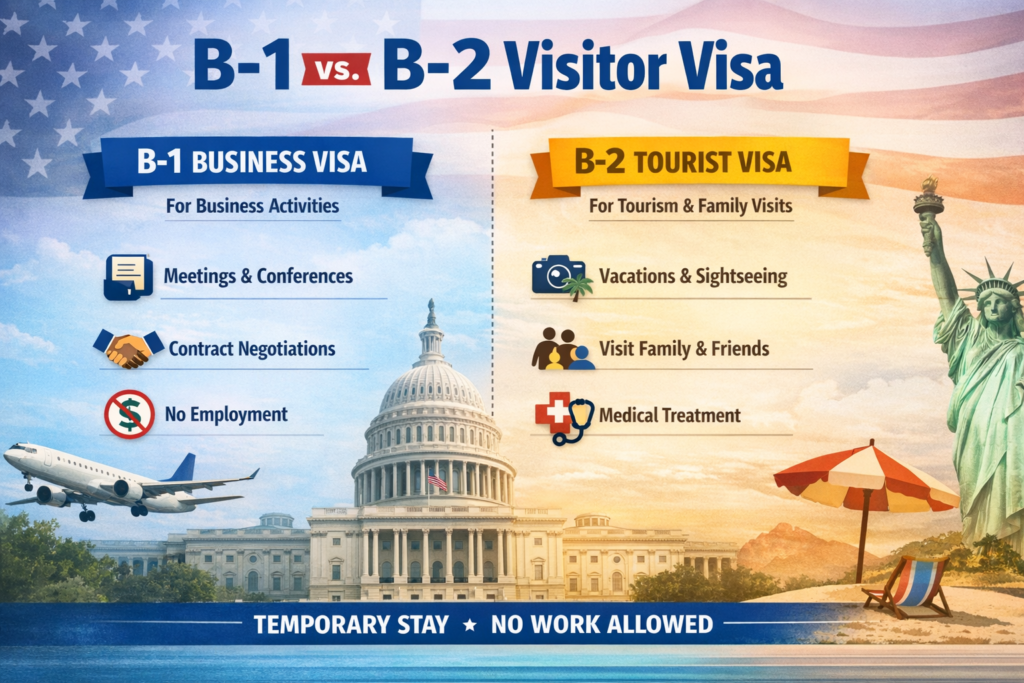
- B-1 = Business travel
- B-2 = Tourism, medical visits, or family visits
These visas are among the most commonly issued U.S. visas worldwide, designed for short-term stays—not permanent relocation.
According to the U.S. Department of State, millions of B-1/B-2 visas are issued annually, reflecting their importance for global travel, business meetings, and tourism.
What Is a B-1 Visitor Visa?
A B-1 visa is a non-immigrant visa for individuals traveling to the U.S. for business-related purposes.
It does not allow employment but supports temporary business activities.
Common B-1 Visa Activities:
- Attending business meetings or conferences
- Negotiating contracts
- Consulting with business associates
- Participating in short-term training (non-paid)
- Settling estates
Key Point:
You cannot earn income from a U.S. source on a B-1 visa.
What Is a B-2 Visitor Visa?
A B-2 visa is a non-immigrant visa for tourism, leisure, and medical purposes.
It is intended for personal, non-business travel.
Common B-2 Visa Activities:
- Tourism and sightseeing
- Visiting family or friends
- Medical treatment
- Participating in social events
- Short recreational courses (non-credit)
Key Point:
The B-2 visa is the standard U.S. tourist visa.
What Is a B-1/B-2 Combined Visa?
A B-1/B-2 visa is a combined visa that allows both business and tourism activities during a single trip.
Why It’s Common:
Most applicants receive this combined visa because:
- It provides flexibility
- It covers both travel purposes
- It simplifies travel planning
Example:
You can attend a business meeting (B-1) and then go sightseeing (B-2) on the same visit.
What Are the Key Differences Between B-1 and B-2 Visas?
The main difference lies in the purpose of travel.
| Feature | B-1 Visa | B-2 Visa |
|---|
| Purpose | Business | Tourism/Medical |
| Work Allowed | ❌ No | ❌ No |
| Typical Use | Meetings, conferences | Vacation, family visits |
| Payment | No U.S. income | No income |
| Activities | Professional | Personal |
Simple Rule:
- Business = B-1
- Leisure = B-2
Who Is Eligible for a B-1 or B-2 Visa?
You are eligible if you can prove temporary intent and strong ties to your home country.
Basic Requirements:
- Valid passport
- Clear purpose of visit
- Proof of funds
- Strong ties (job, family, property)
- Intent to return home
Important Legal Standard:
Under U.S. immigration law (INA Section 214(b)), applicants must prove they are not intending to immigrate permanently.
How Do You Apply for a B-1 or B-2 Visa?
The application process involves several structured steps.
Step-by-Step Process:
- Complete the DS-160 online form
- Pay the visa application fee (currently $185 as per the U.S. Department of State)
- Schedule a visa interview
- Attend an interview at the U.S. embassy/consulate
- Wait for the decision
What Documents Are Required for a B-1/B-2 Visa?
You need documents that prove your identity, purpose, and financial stability.
Essential Documents:
- Passport (valid for at least 6 months)
- DS-160 confirmation page
- Visa appointment confirmation
- Passport-size photo
- Proof of funds (bank statements)
- Travel itinerary
- Employment proof or business documents
Supporting Documents (Optional but Helpful):
- Invitation letter
- Property ownership documents
- Family ties evidence
What Happens During the Visa Interview?
The visa interview is a short but critical step where a consular officer evaluates your intent.
Typical Questions:
- Why are you visiting the U.S.?
- How long will you stay?
- What do you do for a living?
- Who will pay for your trip?
Decision Focus:
The officer mainly checks:
- Your intent to return home
- Financial capability
- Consistency of answers
How Long Can You Stay on a B-1 or B-2 Visa?
You can usually stay up to 6 months per visit, but the final decision is made by CBP officers at entry.
Important Distinction:
- Visa validity = how long you can travel to the U.S.
- Authorized stay = how long you can remain in the U.S.
Example:
You may have a 10-year visa, but only stay 6 months per visit.
What Activities Are Allowed and Not Allowed on These Visas?
B-1/B-2 visas have strict limitations.
Allowed:
- Tourism
- Business meetings
- Medical treatment
- Visiting family
Not Allowed:
- Employment in the U.S.
- Long-term study
- Permanent residence
- Paid performances
Key Risk:
Violating visa terms can lead to visa cancellation or bans.
Can You Extend or Change a B-1/B-2 Visa?
Yes, but only under specific conditions.
Extension:
You can apply for an extension using Form I-539 if:
- You have a valid reason
- You apply before your stay expires
Change of Status:
Possible but limited (e.g., B-2 to student visa)
Important:
Approval is not guaranteed and depends on strong justification.
What Are the Common Reasons for B-1/B-2 Visa Rejection?
Most rejections occur under Section 214(b).
Common Reasons:
- Weak ties to the home country
- Insufficient financial proof
- Unclear travel purpose
- Inconsistent interview answers
- Previous immigration violations
Key Insight:
The most important factor is proving that you will return home.
How Can You Increase Your Chances of Visa Approval?
Strong preparation significantly improves approval chances.
Best Practices:
- Be honest and consistent
- Show stable income/job
- Provide strong financial proof
- Prepare clear travel plans
Verified Data Insight (Updated & Accurate)
Visa approval rates vary significantly by country, based on risk factors like overstays.
According to the U.S. Department of State:
- In FY 2025, B visa refusal rates varied widely:
- Chile: 16.38%
- China: 20.21%
- Colombia: 32.84%
- Cameroon: 60.55%
This shows that approval outcomes differ based on nationality and perceived risk.
Additionally, the U.S. Department of Homeland Security reported that:
- The FY 2023 suspected overstay rate for non–Visa Waiver Program travelers was 3.2%
What This Means:
- Consular officers carefully evaluate whether applicants will return home
- Strong ties and clear intent are the most important approval factors
Key Takeaways About B-1 and B-2 Visas
- B-1 = Business visits
- B-2 = Tourism and personal visits
- B-1/B-2 = Combined flexibility
- No employment allowed
- Stay typically up to 6 months
- Approval depends on proving temporary intent
FAQs About B-1 and B-2 Visitor Visas
What is the difference between a B-1 and a B-2 visa?
B-1 is for business activities, while B-2 is for tourism and personal visits.
Can I work on a B-1 or B-2 visa?
No, employment in the U.S. is not allowed on either visa.
How long is a B-1/B-2 visa valid?
It can be valid up to 10 years, depending on your country.
Can I extend my stay in the U.S.?
Yes, by applying with Form I-539 before your stay expires.
Is a visa a guarantee of entry?
No, the final entry is decided by U.S. Customs and Border Protection.
Can I study on a B-2 visa?
Only short recreational courses are allowed—not full-time study.
Why do visas get rejected?
Mostly due to failure to prove strong ties to the home country.
Conclusion
B-1 and B-2 visas are straightforward in concept but strict in execution. Understanding their purpose, rules, and limitations is the key to approval and compliance.
If you approach the process honestly, prepare your documents well, and clearly demonstrate your intent to return home, your chances of success improve significantly.