How Long Does It Take to Get a Green Card (By Category and Country)?
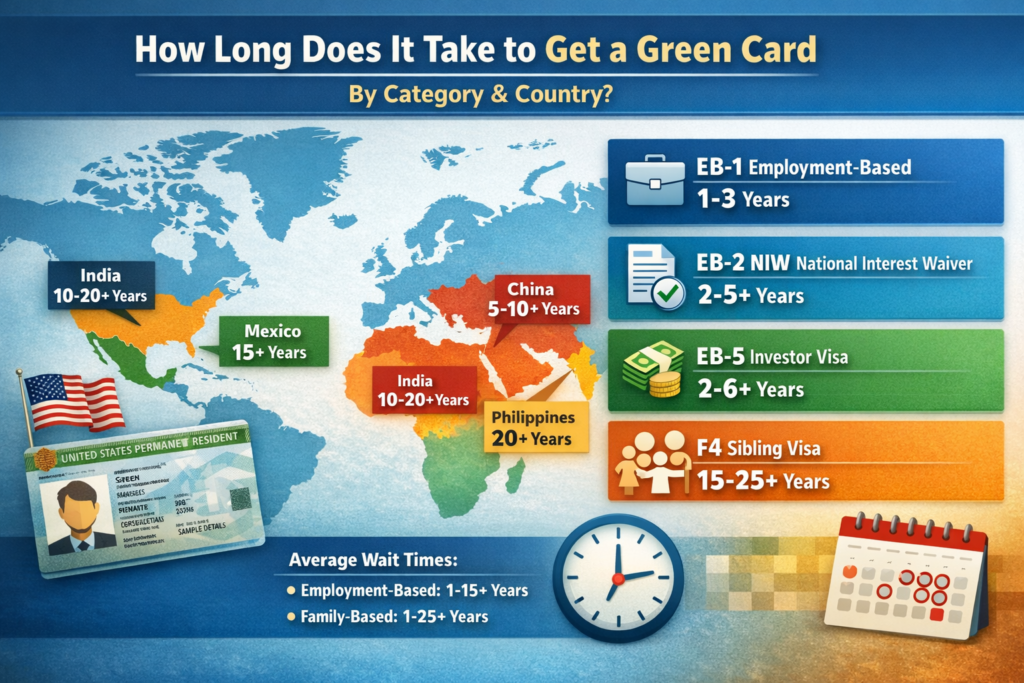
The time to get a U.S. green card ranges from under 1 year to over 20+ years, depending on your category and country of birth. Employment-based categories like EB1 can be relatively fast, while family-based categories like F4 (siblings) can take decades.
This matters because U.S. immigration uses annual limits and country caps, which create long backlogs—especially for applicants from India, China, Mexico, and the Philippines.
Let’s break down timelines clearly by category, country, and pathway.
What is the average green card processing time overall?
The average green card timeline varies widely, but most applicants fall into these ranges:
- Employment-based (EB1–EB3): 1–10+ years
- Family-based (immediate relatives): 1–2 years
- Family preference (F1–F4): 7–25+ years
- EB5 investor: 2–6+ years
Explanation:
The biggest driver is visa availability, not just processing speed. Even if USCIS approves your case quickly, you must wait for your priority date to become current.
Why do green card wait times vary by country?
Green card wait times differ by country due to per-country caps.
Direct answer:
No country can receive more than 7% of total green cards annually, which creates massive backlogs for high-demand countries.
Explanation:
- Countries like India and China submit far more applications than the allowed limits
- This leads to visa retrogression (dates moving backward)
Example:
- EB2 India backlog: often 10–15+ years
- EB1 Rest of World: often current or <1 year
What is the EB1 green card timeline?
EB1 is typically the fastest employment-based green card category, often taking 1–3 years total.
Breakdown:
- I-140 processing: 2–8 months (premium: 15 days)
- Priority date wait:
- Current for many countries
- Backlogged for India/China
- AOS (I-485): 6–12 months
How long does EB1 take for different countries?
- Rest of World: ~1–2 years
- China: ~2–4 years
- India: ~5–8+ years (due to backlog)
Explanation:
Even EB1, which is usually current, has seen increasing backlogs for India in recent years due to demand.
What is the EB2 NIW processing time by country?
EB2 NIW typically takes 2–5+ years, depending on the country.
Breakdown:
- I-140 (NIW): 6–12 months (premium available recently)
- Priority date wait:
- Rest of World: ~0–1 year
- China: ~2–4 years
- India: ~8–12+ years
- AOS: 6–12 months
Insight:
EB2 NIW avoids labor certification, but priority date backlog still applies.
What is the EB5 visa processing time?
EB5 processing usually takes 2–6+ years, depending on investment type and country.
Breakdown:
- Petition (I-526): 12–36 months
- Visa availability:
- Current for many countries
- Backlogged for China and India
- Conditional green card issuance
Recent change:
- The EB5 Reform and Integrity Act (2022) created faster processing for rural investments.
How long does it take to go from H1B to green card?
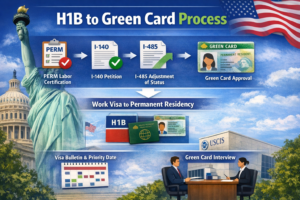
The H1B to green card process takes 2–15+ years, depending on category and country.
Typical stages:
- PERM labor certification: 6–12 months
- I-140 petition: 2–8 months
- Priority date waiting:
- India: up to 10+ years (EB2/EB3)
- Rest of World: often current
- AOS: 6–12 months
What is the family-based green card processing time?
Family-based timelines depend on relationship type:
- Immediate relatives (spouse, parents, children under 21): 1–2 years
- Preference categories (F1–F4): 7–25+ years
Reason:
Immediate relatives are not subject to annual caps, while preference categories are.
What is the F4 sibling visa waiting time by country?
F4 (siblings of U.S. citizens) is the longest wait category, often exceeding 20 years.
Estimated wait times:
- India: ~20–25+ years
- Philippines: ~20+ years
- Mexico: ~15–20 years
- Rest of World: ~14–18 years
Explanation:
F4 has limited annual visas and very high demand, leading to extreme backlogs.
What is the AOS (Adjustment of Status) timeline?
AOS typically takes 6–12 months after the priority date becomes current.
Steps:
- File I-485
- Biometrics: 1–2 months
- Work/travel permit: 3–6 months
- Interview (if required)
- Final decision
Important:
AOS only begins when your priority date is current in the Visa Bulletin.
Which green card category is the fastest?
The fastest categories are:
- EB1 (especially EB1A extraordinary ability)
- Immediate relative family visas
- EB5 (rural investments in some cases)
Reason:
- No backlog or shorter queues
- Faster adjudication processes
Which green card category has the longest wait time?
The longest wait times are:
- F4 sibling visas
- EB2/EB3 for India
- Family preference categories (F1–F3)
These can exceed 20+ years due to demand and quotas.
What factors affect green card wait times?
Key factors include:
- Country of birth (the biggest factor)
- Category (EB vs family)
- Visa Bulletin movement
- USCIS processing speed
- Policy changes and demand
Additional factors:
- Retrogression
- Application errors or RFEs
- Interview requirements
What is a comparison of green card wait times by category?
| Category | Typical Wait Time | Notes |
|---|
| EB1 | 1–3 years | Fastest employment-based |
| EB2 NIW | 2–5+ years | Backlog for India/China |
| EB5 | 2–6+ years | Faster for rural |
| H1B → GC | 2–15+ years | Depends on country |
| Immediate family | 1–2 years | No caps |
| F4 sibling | 14–25+ years | Longest wait |
How can you check your green card priority date and wait time?
You can check your wait time using the Visa Bulletin published monthly by the U.S. Department of State.
Steps:
- Find your priority date (from I-140 or I-130 receipt)
- Check the Visa Bulletin chart
- Compare with your category and country
- If “current,” you can proceed
Key Takeaways
- Green card timelines vary from 1 year to over 25 years
- Country caps are the main reason for delays
- EB1 and immediate family are the fastest
- F4 sibling category is the slowest
- Always track your priority date and the Visa Bulletin
FAQs
How long does it take to receive a green card after approval?
Usually 6–12 months, depending on AOS or consular processing.
What is the fastest way to get a green card?
EB1 or immediate family sponsorship are typically the fastest.
Why does India have the longest wait times?
Due to high demand and the 7% country cap limit.
Can green card wait times change?
Yes, due to visa retrogression and policy changes.
What is the priority date for a green card?
It is your place in the queue for visa availability.
Is EB1 faster than EB2?
Yes, EB1 generally has shorter wait times.
How long is EB2 NIW taking now?
Typically 2–5+ years, depending on the country.
Conclusion
Green card timelines are not fixed—they depend heavily on your category and country of birth. Understanding priority dates, visa backlogs, and category differences is essential for planning your immigration journey wisely.