Can You Work in the USA on a Visitor or Tourist Visa?
If you’re planning a trip to the United States, you might wonder: Can I work while I’m there on a visitor or tourist visa?
The short and clear answer is no — you cannot legally work in the U.S. on a visitor visa (B-1 or B-2).
This rule is strictly enforced under U.S. immigration law. Working without authorization can lead to serious consequences, including visa cancellation, deportation, and even long-term bans on re-entry.
Let’s break this down clearly so you know exactly what’s allowed, what’s not, and your options.
Is it legal to work in the U.S. on a visitor visa?
No, it is illegal to work in the United States on a visitor (tourist) visa.
According to the U.S. Department of State, visitor visas (B-1/B-2) are strictly for temporary visits, not employment.
Why this matters:
- Visitor visas do not include work authorization
- Any paid activity for a U.S. employer is considered unauthorized work
- Even short-term or informal jobs count as violations
Key rule:
If you are earning money from a U.S. source while physically in the U.S., it is usually considered illegal without proper authorization.
What is a B-1/B-2 visitor visa, and what does it allow?
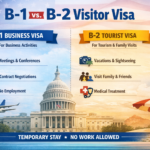
A B-1/B-2 visa is a non-immigrant visa for short-term visits.
Two main types:
- B-1 (Business Visitor)
- B-2 (Tourist/Leisure Visitor)
Allowed activities include:
- Tourism and sightseeing
- Visiting family or friends
- Attending conferences or meetings
- Medical treatment
- Short business discussions (no employment)
These visas are governed by U.S. Citizenship and Immigration Services guidelines.
What activities are allowed on a tourist visa?
Tourist visa holders can only engage in non-work-related activities.
Examples of allowed activities:
- Traveling across U.S. cities
- Attending weddings or family events
- Participating in unpaid events
- Taking short recreational courses
Not allowed:
- Taking a job
- Running a business actively
- Providing paid services
What counts as “work” under U.S. immigration law?
“Work” includes any activity where you receive compensation or provide services.
This includes:
- Full-time jobs
- Part-time jobs
- Freelancing
- Self-employment
- Helping in a business (even family-owned)
Important detail:
Even if you are paid cash, foreign income, or unofficially, it can still count as unauthorized work.
Can you do remote work or freelancing on a visitor visa?
This is a gray area, but generally risky and often not allowed.
The key factor:
- If your work is tied to a non-U.S. employer and paid outside the U.S., it may be tolerated in some cases
- However, U.S. authorities can still interpret it as unauthorized work
Risks:
- Border officers may deny entry
- Visa can be revoked
- Future visa applications may be affected
👉 There is no clear official rule fully permitting remote work on a tourist visa, so caution is essential.
Are there any exceptions where earning money is allowed?
Can business visitors (B-1 visa) receive payment?
In limited cases, yes — but only under strict conditions.
Examples include:
- Payments from a foreign employer
- Certain honoraria for academic activities (under specific rules)
Can you be paid by a U.S. company?
Are reimbursements or allowances allowed?
Yes, reimbursements are usually allowed.
Examples:
- Travel expenses
- Accommodation costs
- Meal allowances
But these must not be considered salary or wages.
Why does the U.S. prohibit working on a tourist visa?
The main reason is to protect the U.S. labor market.
Key reasons:
- Prevent unfair competition with local workers
- Maintain immigration control
- Ensure proper taxation and legal compliance
The system ensures that only individuals with proper work visas can participate in the U.S. workforce.
What happens if you work illegally on a visitor visa?
The consequences can be severe and long-lasting.
Possible penalties:
- Immediate visa cancellation
- Deportation (removal proceedings)
- Entry bans (3-year or 10-year bans under U.S. law)
- Future visa denials
According to U.S. Customs and Border Protection, immigration violations are taken seriously at entry points.
Can you change a tourist visa to a work visa?
Yes, but only under specific legal procedures.
Options:
- Apply for a change of status through USCIS
- Leave the U.S. and apply for a work visa abroad
Important:
- You cannot start working until your work visa is approved
- Unauthorized work can ruin your chances of approval
What visas allow you to work legally in the U.S.?
You must have a valid work-authorized visa to work legally.
Common work visas:
| Visa Type | Purpose |
|---|
| H-1B | Skilled professionals |
| L-1 | Intra-company transfer |
| O-1 | Individuals with extraordinary ability |
| F-1 (OPT) | Students with work authorization |
| E-2 | Investors |
Each visa has its own requirements and eligibility criteria.
What are common myths about working on a tourist visa?
Myth 1: “Small jobs are okay.”
❌ False — all unauthorized work is illegal
Myth 2: “Cash jobs don’t count.”
❌ False — payment method doesn’t matter
Myth 3: “Remote work is always allowed.”
❌ Not officially true — it’s risky
Myth 4: “No one will find out.”
❌ Immigration checks can happen anytime
What are safer alternatives if you want to work in the U.S.?
The safest approach is to apply for a proper work visa.
Better options:
- Apply for an H-1B through an employer
- Study in the U.S. and use OPT
- Explore investor or business visas
- Seek sponsorship
Key Takeaways
- You cannot legally work in the U.S. on a tourist or visitor visa
- Even small or informal jobs count as violations
- Remote work is risky and not clearly allowed
- Violations can lead to bans and deportation
- The safest path is to obtain a valid work visa
FAQs
Can I work part-time on a tourist visa?
No. Any form of employment is not allowed.
Can I work online for a foreign company while visiting the U.S.?
It’s a gray area and risky; not officially permitted.
What happens if I get caught working illegally?
You may face deportation, visa cancellation, and bans.
Can I volunteer instead of working?
Only if it’s truly unpaid and not replacing a paid role.
Can I switch from a tourist visa to a work visa inside the U.S.?
Yes, but you must not work until approval.
Is freelancing allowed on a visitor visa?
No, freelancing is considered work and is not allowed.
Can I help in a family business for free?
Even unpaid help may be considered unauthorized work.
Conclusion
If you’re asking whether you can work in the U.S. on a visitor visa, the answer is simple: don’t risk it.
The rules are strict, and violations can affect your future permanently. If your goal is to work in the U.S., the best move is to follow the legal path and apply for the right visa.