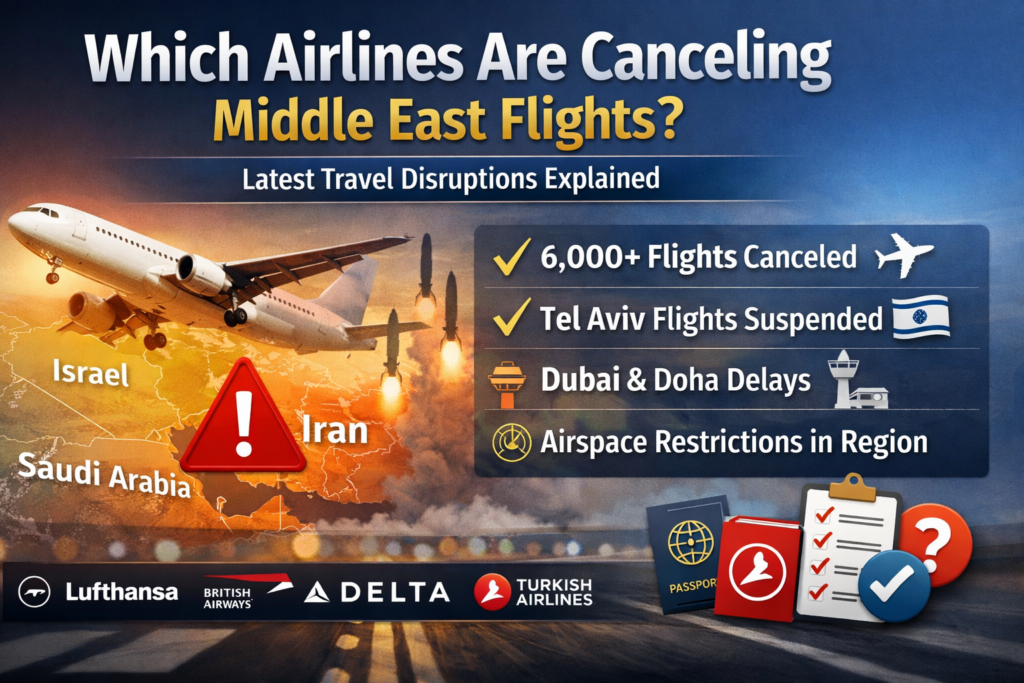
Which Airlines Are Canceling Middle East Flights?
Airlines around the world have temporarily canceled or reduced flights to parts of the Middle East due to security concerns, airspace restrictions, and regional conflict escalation.
Recent disruptions have affected thousands of flights globally and forced airlines to suspend routes to several destinations—including Israel, Iran, and some Gulf airports—while rerouting aircraft to avoid risky airspace.
For travelers planning trips to the Middle East, understanding which airlines are canceling flights, which destinations are affected, and what to do if your flight changes is essential.
What Is Happening With Middle East Flight Disruptions Right Now?
Middle East flight disruptions escalated in early 2026 after geopolitical tensions triggered airspace closures and safety warnings from aviation authorities.
According to reporting from Reuters, more than 6,000 flights were canceled across seven Middle East countries, making the situation one of the largest aviation disruptions since the COVID-19 pandemic.
One of the world’s busiest hubs, Dubai International Airport, accounted for more than 3,000 canceled flights during the initial disruption phase.
Why this matters for travelers:
The Middle East is a major transit corridor between Europe, Asia, and Africa
Many long-haul routes pass through Gulf hubs like Dubai, Doha, and Abu Dhabi
Even flights not going to the Middle East may be affected because aircraft normally cross its airspace
Global aviation analytics from OAG show that the airline industry operates about 102,000 commercial flights per day worldwide, meaning disruptions in one region can quickly ripple across the entire global network.
Why Are Airlines Disrupting Flights Across the Middle East?
Flights are being disrupted primarily because airlines must follow aviation safety warnings and airspace restrictions.
Airlines suspend routes when operating conditions become unsafe for commercial aircraft.
Common causes include:
Military conflict near airports
Missile or drone threat alerts
Government travel advisories
Restricted airspace corridors
Insurance limitations for airlines
The European Union Aviation Safety Agency (EASA) issued a conflict-zone bulletin warning that some parts of the region carry “high risk for civil aviation operations.”
Airlines must therefore make operational decisions that prioritize safety, even if airports technically remain open.
Which Airlines Have Canceled or Suspended Middle East Flights?
Multiple airlines from Europe, North America, and Asia have canceled or suspended flights to destinations in the Middle East.
The exact list changes frequently, but recent airline announcements include several major international carriers.
Airline disruption snapshot
| Airline | Affected Routes | Status |
|---|
| British Airways | Abu Dhabi, Doha, Dubai, Tel Aviv | Suspensions during conflict escalation |
| Lufthansa Group | Tel Aviv, Beirut, Dubai, Tehran | Multiple route pauses |
| ITA Airways | Tel Aviv, Dubai | Temporary cancellations |
| Japan Airlines | Tokyo–Doha | Suspended during peak disruption |
| LOT Polish Airlines | Dubai, Tel Aviv, Riyadh | Short-term cancellations |
| Malaysia Airlines | Doha | Temporary suspension |
| Turkish Airlines | Iraq, Lebanon, Jordan, Gulf routes | Regional cancellations |
| Wizz Air | Israel and Gulf destinations | Route suspensions |
| Delta Air Lines | New York–Tel Aviv | Extended pause |
These airlines paused routes for safety reasons and to comply with aviation authority guidance.
Which European airlines suspended flights?
Several European carriers temporarily suspended flights to Israel and other affected destinations.
Examples include:
These airlines generally continue flights to major Gulf hubs but suspend service to locations considered high risk.
Which U.S. airlines paused Middle East routes?
Major U.S. airlines have historically operated routes such as New York to Tel Aviv, but many paused these services during disruptions.
Examples include:
Delta Air Lines
United Airlines
American Airlines
Delta extended its suspension of the New York–Tel Aviv route through March 2026.
Are Middle Eastern airlines canceling flights?
Regional carriers usually maintain more operations within the Middle East but still adjust schedules depending on security conditions.
Major airlines in the region include:
Emirates
Qatar Airways
Etihad Airways
Saudia
Turkish Airlines
Flydubai
These airlines may:
Some carriers operate limited schedules rather than full cancellations.
Which Airports and Destinations Are Most Affected?
Airports closest to active conflict zones experience the most disruptions.
Commonly affected locations include:
However, large Gulf hubs usually remain operational.
Are flights to Israel being canceled?
Yes. Tel Aviv’s Ben Gurion Airport has been the most consistently affected airport during disruptions.
Reasons include:
As a result, many international airlines temporarily suspend flights to Israel during periods of instability.
Are flights to Gulf countries still operating?
Yes. Flights to Gulf countries such as the United Arab Emirates and Qatar often continue operating.
Major hubs include:
Dubai International Airport
Hamad International Airport (Doha)
Abu Dhabi International Airport
These airports are major global aviation hubs and often remain operational even when nearby regions experience disruptions.
However, flights may operate on reduced schedules.
Are Airlines Avoiding Middle East Airspace?
Yes. Airlines frequently reroute flights to avoid risky airspace.
During the latest disruption, flight tracking data showed restrictions affecting several countries, including:
Iran
Iraq
Syria
Israel
Qatar
Bahrain
Kuwait
parts of Saudi Arabia
Instead of flying directly through these areas, aircraft may:
This can increase flight time and operating costs.
How Do Airlines Decide When to Cancel Flights?
Airlines rely on risk assessments and official aviation guidance.
Key factors include:
Government aviation advisories
Civil aviation authority warnings
Airspace restrictions
Insurance coverage conditions
Airline operational risk analysis
Organizations that influence airline decisions include:
International Civil Aviation Organization (ICAO)
European Union Aviation Safety Agency (EASA)
U.S. Federal Aviation Administration (FAA)
When safety concerns increase, airlines may suspend flights immediately.
What Should Travelers Do If Their Middle East Flight Is Cancelled?
If a flight is canceled due to regional disruption, airlines typically provide rebooking options or refunds.
Passengers should take action quickly to secure alternative travel.
How can passengers check flight disruptions?
Travelers should check flight status using official airline channels.
Best options include:
Avoid relying solely on third-party booking websites.
What refund or rebooking options exist?
Airlines typically offer flexible policies during disruptions.
Common options include:
Passengers should contact the airline directly for the fastest resolution.
How Long Could Middle East Flight Disruptions Last?
There is no fixed timeline for disruptions.
Flights usually resume when:
aviation authorities declare airspace safe
Governments remove travel advisories
airlines complete safety assessments
In previous aviation crises, disruptions lasted anywhere from several days to multiple weeks.
Even after restrictions are lifted, airlines may need time to restore full schedules.
Key Takeaways for Travelers
Middle East flight disruptions are usually caused by safety risks or geopolitical tensions.
More than 6,000 flights were canceled during the latest disruption phase.
Major airlines from Europe, North America, and Asia have suspended routes.
Israel’s routes are often the most affected.
Gulf aviation hubs like Dubai and Doha usually remain operational.
Travelers should check airline updates before departure.
Frequently Asked Questions
Which airlines are canceling flights to the Middle East?
Airlines such as Lufthansa, British Airways, Delta Air Lines, ITA Airways, Turkish Airlines, and Wizz Air have temporarily suspended some routes during recent disruptions.
Are flights to Israel currently operating?
Many airlines periodically suspend flights to Tel Aviv during periods of instability, though service often resumes once safety conditions improve.
Are flights to Dubai affected?
Flights to Dubai usually continue operating, although schedules may change due to regional airspace restrictions.
Why do airlines cancel flights during conflicts?
Airlines cancel flights when aviation authorities warn about safety risks such as missile threats, airspace closures, or military activity.
Can travelers get refunds if flights are canceled?
Yes. Most airlines offer refunds, rebooking options, or travel credits when flights are canceled due to safety disruptions.
How can travelers track flight disruptions?
Travelers should check airline websites, flight tracking tools, and official travel advisories for the latest updates.