Ramadan 2026 Moon Sighting: Why Astronomers Say February 17 Is Unsafe & Impossible
Quick Summary (What You Need to Know)
The Ramadan crescent cannot be seen on February 17, 2026, anywhere in the Middle East
The moon will sit extremely close to the sun, making visibility scientifically impossible
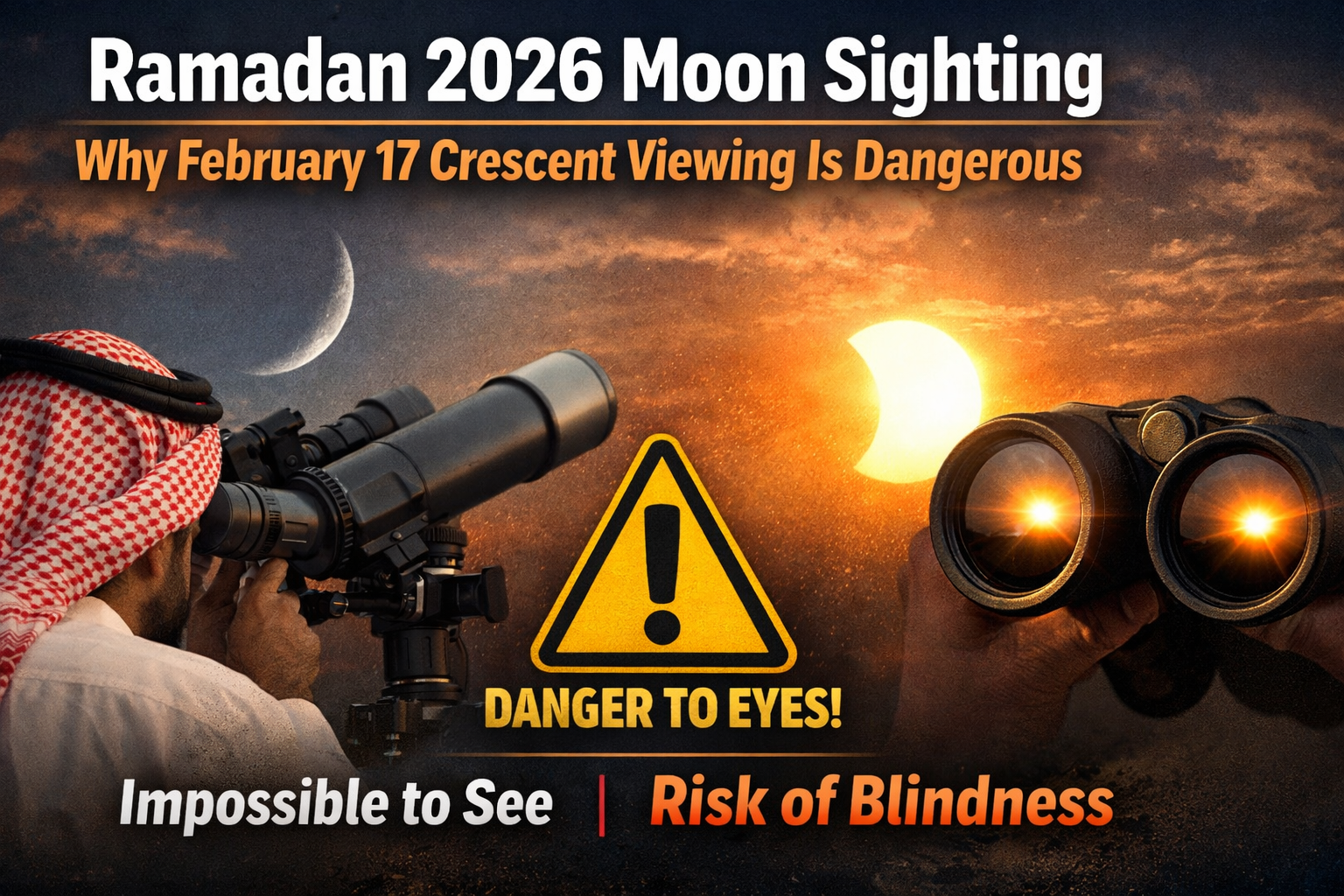
Trying to observe it with telescopes or binoculars could cause serious eye damage
Several Gulf astronomers warn that unsafe viewing may lead to temporary or permanent blindness
Some countries may still announce Ramadan on Feb 18 despite astronomical data
UAE, Oman, Jordan, and international astronomers strongly advise not attempting observation
Why February 17 Crescent Viewing Is Dangerous and Astronomically Impossible
Astronomers across the Gulf region are issuing unusually strong warnings ahead of the expected Ramadan moon sighting on February 17, 2026. According to scientific calculations, the crescent moon will be positioned dangerously close to the sun — so close that trying to observe it is not only futile, but potentially harmful.
Experts say the angular separation between the moon and sun at sunset will be around one degree. To put that into perspective, that’s an incredibly tight margin in the sky. Even if a crescent technically exists, it would be drowned in the sun’s glare, making it invisible to the naked eye and even to advanced telescopes.
And here’s the bigger concern: looking toward that region of the sky without proper certified solar filters can severely damage eyesight.
The Real Risk: Eye Injury From Unsafe Observation
Astronomy organizations in the UAE, Jordan, and beyond have emphasized that public attempts to sight the moon using binoculars or telescopes could lead to retinal burns and permanent vision damage.
When optical instruments are pointed near the sun, they concentrate sunlight into the eye. That concentrated radiation can silently burn retinal tissue — often without immediate pain — meaning damage may only be noticed after it’s already irreversible.
Medical experts warn:
The retina is extremely sensitive to solar radiation
Damage can happen instantly and painlessly
Burns may result in partial or permanent vision loss
Regular sunglasses offer zero protection
Only certified eclipse glasses or professional-grade solar filters make observation safe — and even then, astronomers say the crescent still won’t be visible.
Why Scientists Say the Crescent Cannot Be Seen
Even if observers wait until the sun sets completely, astronomers explain that the moon will already be below the horizon. In other words, there will be nothing left to search for.
The moon’s position relative to the sun makes crescent visibility astronomically impossible across Asia, Africa, and Europe on that day. Multiple astronomical centers, including those in the UAE and Jordan, confirm that the calculations agree worldwide.
This is why Oman and other countries have already announced Ramadan dates in advance, choosing to follow scientific certainty rather than uncertain sightings.
The Ongoing Debate: Science vs Tradition
Some countries traditionally rely on physical moon sightings, even when astronomers insist visibility is impossible. This difference between religious tradition and astronomical science has sparked debate for years.
Many experts expect that, despite scientific consensus, certain authorities may still declare Ramadan based on reported sightings. Others are moving toward a unified calendar system grounded in astronomical data to reduce confusion.
What’s clear this year is the strong emphasis on safety: astronomers are prioritizing public health over tradition when it comes to dangerous observation attempts.
Final Advice From Astronomers
Experts across the region agree on one thing:
Protect your eyesight. Do not attempt to sight the moon on February 17 without certified professional equipment.
Even professionals will treat this alignment with caution. For the public, the safest choice is simple: trust the scientific advice and avoid risky observation.
Ramadan will arrive — but your vision should last a lifetime.